

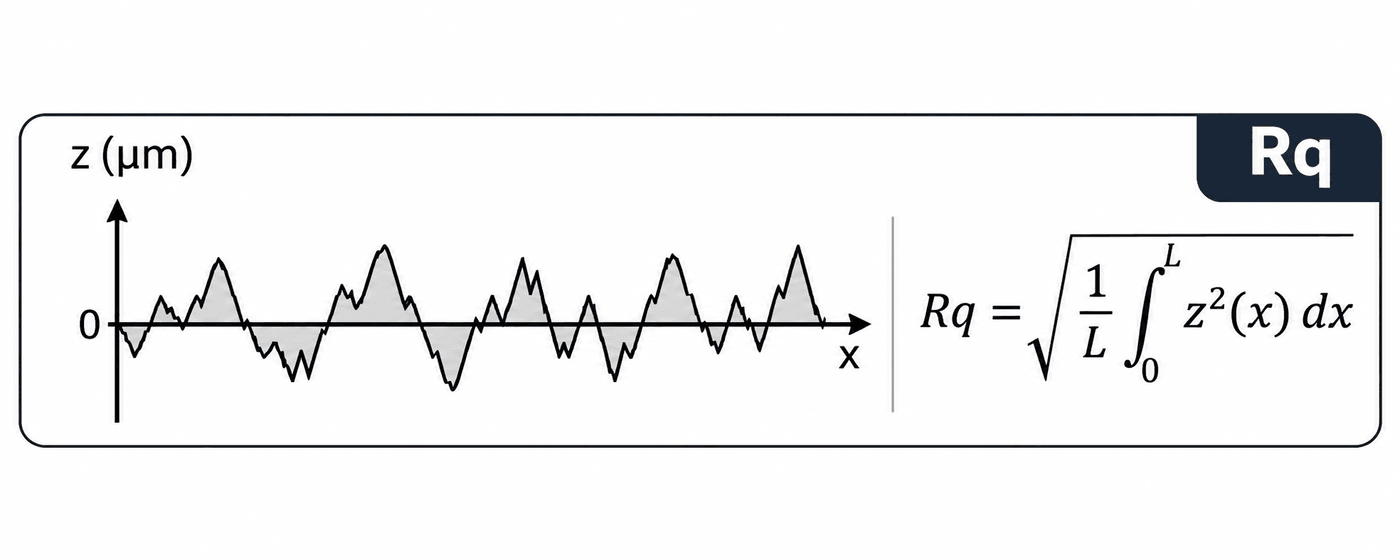
What is Rq? (Root mean square roughness)
Rq is a profile parameter calculated by taking the square root of the mean of the squared height deviations. Because of the squaring, large deviations carry more weight. Rq can therefore make the effect of individual high peaks or deep valleys more visible than Ra. On the same profile, Rq is never smaller than Ra. It should be remembered that Rq alone is not a guarantee of functional surface performance.
What is Rz? (Maximum height of the profile)
Rz is an important parameter related to the peak-to-valley height of the profile. However, the definitions used for the name Rz have changed over time and between different standards. In older ISO/JIS drawings, Rz may be interpreted as the average of the results of several sampling sections, whereas the ISO 21920 series uses a definition related to the evaluation range of the maximum height parameter. When evaluating a value such as "Rz 3 µm", the measurement standard, its version and the measurement settings must therefore always be asked for.
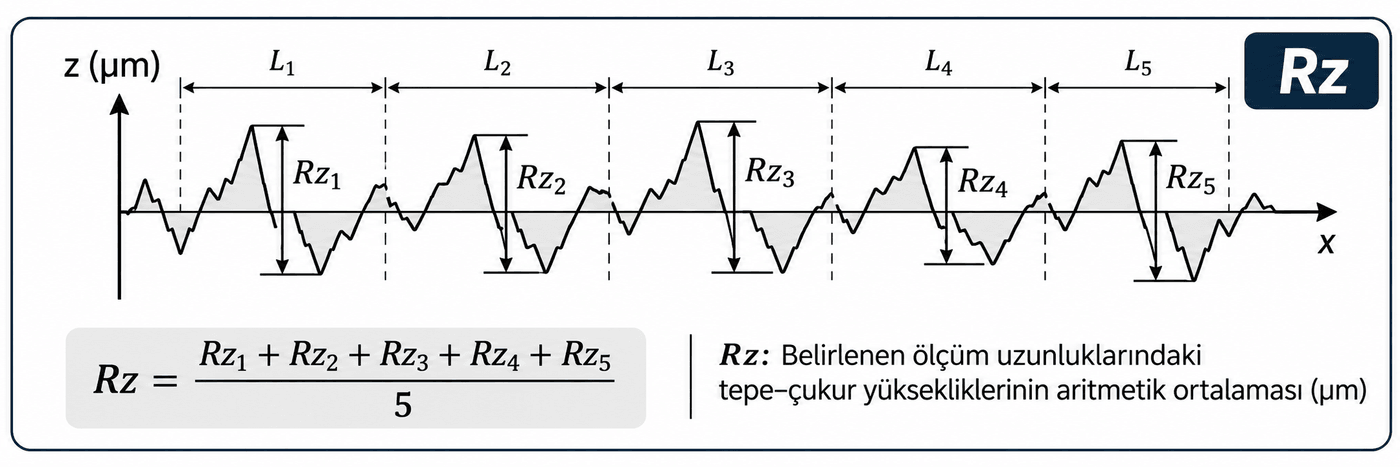
Why does it matter? Even if the average roughness is low, a deeper groove or a high peak can change the contact, friction and sealing behaviour of the part. Rz looks at this kind of protrusion/valley character from a different angle than Ra.
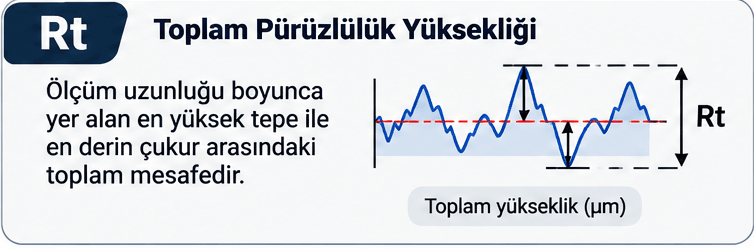
What is Rt? (Total height of the profile)
Rt expresses the total height difference between the highest peak and the deepest valley of the roughness profile within the evaluation length. It is sensitive to extreme values. A single scratch or notch can significantly affect the Rt result. The settings of the measuring instrument, the cleanliness of the profile and the choice of standard are important for the result.
What are Rp and Rv?
Rp is the height of the highest peak relative to the mean line of the roughness profile under the evaluation conditions; Rv is the depth of the deepest valley. Because peak and valley directions can have different functional consequences, these parameters are especially useful in evaluating wear, surface contact and sealing.
What are Rmax and Ry?
The terms Rmax and Ry can be found on older technical drawings and on different measuring instruments. How they are calculated and interpreted depends on the standard and version used. Rmax/Ry values in older reports in particular should not be regarded as directly the same as the current Rt or Rz. If the technical drawing contains only the symbol, the customer should be asked for the standard reference and the measurement method.
What is Ri? A frequently confused term
Ri is not a universal, standard lapping roughness parameter used in every profile report like Ra. In some machining studies, Ri is used as an abbreviation for the ideal/theoretical average surface roughness. In turning, for example, there are idealised geometric approaches based on the feed rate and the tool nose radius. This approach does not give the actual Ra result of a lapped surface. If "Ri" appears on a drawing or an instrument display, the instrument manual or drawing note must be checked to confirm what the symbol means. No general equation such as Ri = Ra or Ri = Rz can be made.
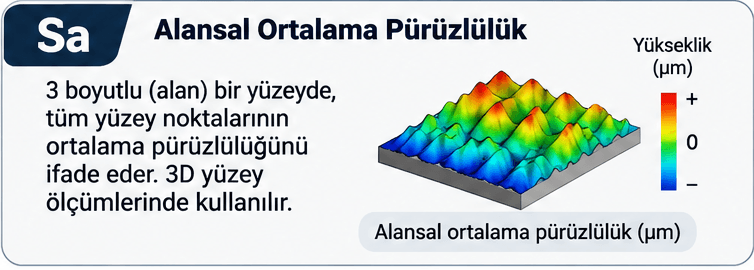
What are Sa, Sq and Sz? (3D surface parameters)
While parameters such as Ra/Rq/Rz are generally evaluated along a single profile line, Sa, Sq and Sz are areal parameters relating to the three-dimensional topography of a measured surface area. Sa expresses the mean absolute height deviation over the area, Sq the root mean square height of the area, and Sz the total height between the highest peak and the deepest valley of the area. On the same part, Ra and Sa do not have to be numerically equal; because of different data acquisition, filtering and the area/line approach, there is no general conversion factor.
What are Rsk and Rku?
Rsk (skewness) describes whether the surface height distribution is dominated by peaks or valleys. Negative values may indicate a valley-dominated profile and positive values a peak-dominated profile. Rku (kurtosis) gives information about how prone the height distribution is to sharp extreme values. Especially in contact and lubrication applications, it can help explain why two surfaces with the same Ra value can behave differently.
What are Rmr(c), Rk, Rpk and Rvk?
Rmr(c) is the material ratio of the profile at a specified section height; in other words, it can be used to interpret the proportion of the surface that carries load. Functional profile parameters such as Rk (core roughness depth), Rpk (reduced peak height) and Rvk (reduced valley depth) are related to the Abbott–Firestone / material ratio curve. When evaluating oil retention, running-in wear and contact behaviour, these parameters can be more informative than Ra in some applications. The version of the standard in which the definitions are used must be consistent with the technical specification.
ISO standards and reading technical drawings
The ISO 21920 series forms the current basic framework for the specification and evaluation of profile-based surface texture. ISO 21920-1 covers the indication of surface texture, ISO 21920-2 the terms and parameters, and ISO 21920-3 the specification operators and measurement conditions. References such as ISO 4287 / ISO 4288 may be encountered on older drawings; it may not be correct to transfer a symbol written on an old drawing one-to-one to the current standard automatically. ISO 25178 relates to three-dimensional (areal) surface texture. ISO 1101 is one of the basic standards for interpreting geometric tolerance symbols, including flatness and parallelism.