

Service
Lapping
Lapping is a precision abrasive machining method that aims to improve the surface geometry and roughness of a workpiece by removing a small, controlled amount of material from its surface.
In conventional lapping, abrasive grains are suspended in a fluid carrier and remove material on a micro scale as the lapping plate and the workpiece move relative to each other. Lapping focuses on final surface quality rather than rough stock removal.
The aim is not only a smoother appearance. For mating surfaces, sealing elements, precision discs and similar parts, flatness and the functional contact pattern are important. The achievable results vary depending on the hardness of the material, the initial surface, the workpiece thickness, the carrier, the plate condition, the abrasive grain size and the process parameters.
What problems can lapping solve?
Surface peaks left by turning, milling, grinding or previous operations can be reduced with a suitable lapping process. This can improve roughness, change the contact area or improve the flatness of the surface. The method is especially valuable for parts that require surface finishing with a small stock allowance.
Lapping is not a method that economically corrects deep notches, severe form errors or large thickness differences in every case. For such parts, suitable grinding or another preparatory operation may be needed first.
Double-sided lapping
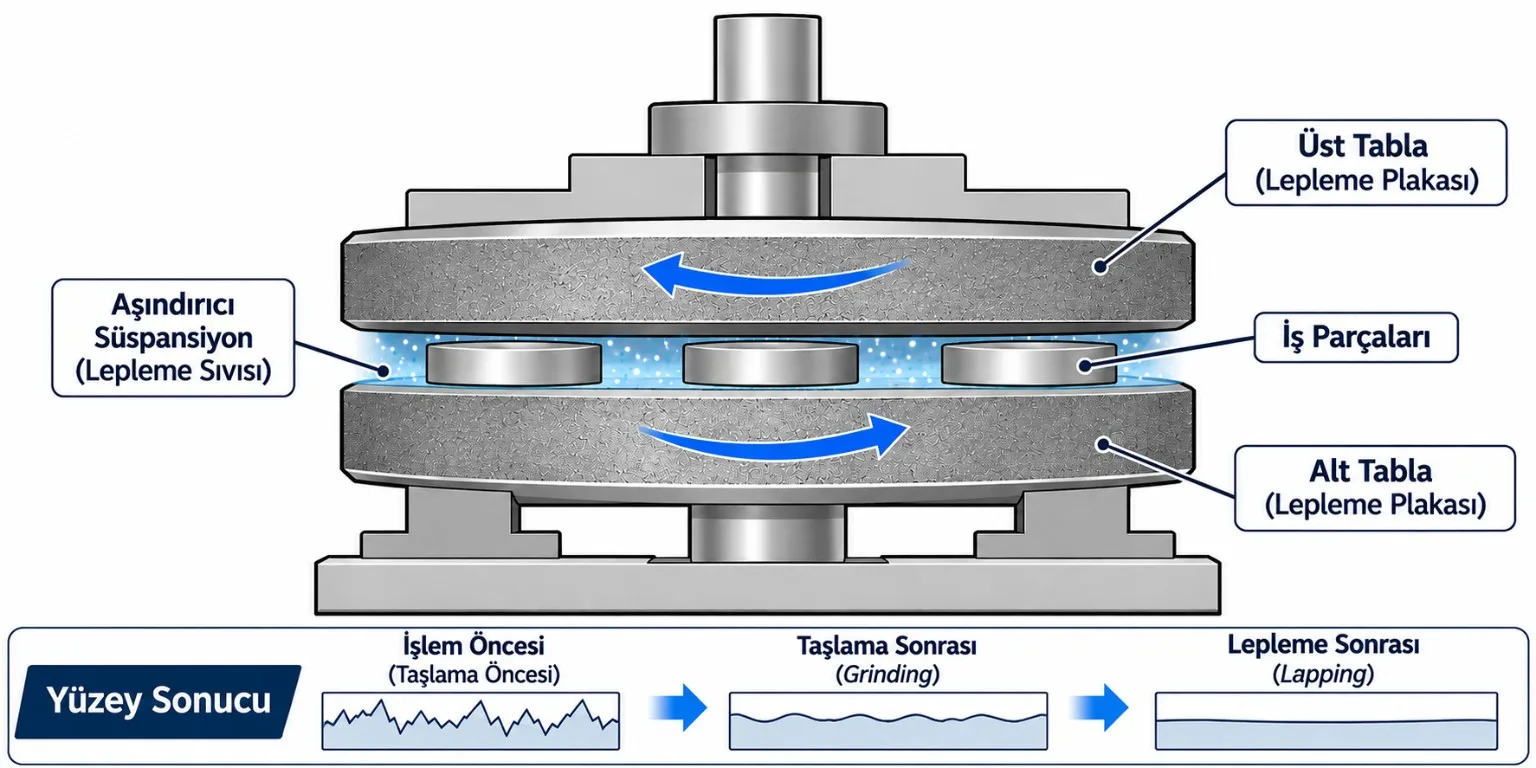
Double-sided lapping is the machining of two opposing surfaces of a workpiece between upper and lower lapping plates in the same process cycle. The parts are placed in the pockets of carrier (planetary) plates. The rotation of the carriers about their own axes and their movement within the machine make the workpieces follow different contact paths across the plates. Under suitable process conditions, this kinematics contributes to controlled wear on both surfaces and more consistent results across the thickness.
Double-sided lapping machines may have upper and lower cast iron plates or plates with other properties. The loose abrasive slurry works between the two contact zones. Because both faces of the part are machined at the same time, it can be a suitable process especially for parallelism, thickness variation and flatness targets; however, the final values are not automatically guaranteed for every part and every machine.
The carriers hold the workpieces in their pockets and, with a suitable design, travel around the machine while rotating about their own axes through a sun/ring gear mechanism. Carrier thickness, pocket clearance, material and gear compatibility can be critical.
Which parts are suitable for lapping?
Typical examples are discs, rings, washers, some flanges, valve plates, spacers and sealing contact parts with two flat or nearly flat opposing functional surfaces. However, whether a part is suitable for lapping does not depend only on its outer diameter: part thickness, tendency to deflect, holes, protrusions, non-flat areas, material hardness and its placement in the carrier must be evaluated together.
Expected technical characteristics
We define quality not merely as a shiny appearance but as surface performance suited to the function of the part. The required Ra value of a part may be important; however, flatness, parallelism, dimensional deviation, burrs and cleanliness must be evaluated to the same extent. Once the required measurements and acceptance criteria have been clarified on the technical drawing or work order, a suitable process plan is drawn up.
Conventional lapping processes using a cast iron plate and loose abrasive can leave a matte or satin grey surface on many metals. This does not mean that the process has failed.
Sample and series production approach
In precision surface finishing, the first goal is to determine the right abrasive and process conditions for the part. For a new material or a different surface expectation, sample work can reduce the technical risk of subsequent production runs. During sampling, thickness, appearance and surface character before and after processing are compared according to the available measurement capabilities. The approved process is then planned for suitable quantities and lead times.
What information should you send?
The part name or code, technical drawing, material grade, hardness, initial and required thickness, tolerances, flatness/parallelism expectations, Ra/Rz targets if any, an image marking the surfaces to be processed, annual/batch quantity and expected lead time all speed up the quotation process. A suitable file transfer method should be used for confidential technical drawings.
Precision Lapping and Polishing

Kemet products are used in our precision lapping and polishing operations.
SSS
Frequently asked questions
What is lapping used for?
It is used to improve the surface texture and certain geometric characteristics of metal and other suitable workpieces through controlled micro-abrasion. It can be considered especially for surfaces where flatness and functional contact are expected.
What is double-sided lapping?
It is the machining of two opposing surfaces of a part between upper and lower lapping plates in the same process. The parts are usually held in the pockets of planetary carriers.
Are lapping and double-sided grinding the same?
No. Conventional lapping relies on a loose abrasive slurry, whereas double-sided grinding is carried out with opposing bonded abrasive wheels. The fact that both use carrier systems does not remove this basic distinction.
Why does a lapped surface look matte grey?
Some applications using a cast iron plate and loose abrasive create a matte or satin surface that diffuses light. This can be a functionally suitable result.
Does lapping always give a mirror finish?
No. A mirror finish is a separate optical/visual requirement and may need special polishing stages.
What is parallelism?
It is an orientation requirement of a surface relative to a specified reference surface. It can be important for parts that function on both faces.
Which parts are suitable for lapping?
Discs, spacers, washers, rings, valve plates and some sealing elements with suitable flat surfaces can be considered. Final suitability is checked according to the carrier and machine capacity.
Why do scratches occur in lapping?
Different causes such as contamination with coarse abrasive, plate/carrier damage, dirt, the fluid film or incorrect process conditions can play a role. Visual inspection and controlled trials are required.
Can I send a sample before processing?
You can request sample work together with the technical drawing, material and required surface conditions. Suitability and acceptance criteria are clarified after the evaluation.
How much material is removed by the process?
It varies according to the part, initial thickness, target dimension, abrasive and process time. There is no fixed universal value.
In which industries is it used?
Lapping and double-sided grinding are generally used in automotive, machine building, valves/pumps, sealing, hydraulics and suitable precision mechanical parts.
Can grinding be required before lapping?
Yes. If the initial surface is rough or a large amount of stock must be removed, suitable grinding can be considered as a preliminary operation.
Can all deep scratches on the surface be removed by lapping?
Not always. The stock needed to remove deep scratches may exceed the dimensional tolerance of the part. In such cases, an alternative preparatory operation is needed.
Let us review your part.
Send us your technical drawing and target surface requirements, and we will determine the right process together.