

Service
Double-Sided Grinding
Double-sided grinding (double-disc grinding / double-side face grinding) is a precision stock removal method in which two opposing surfaces of a workpiece are machined simultaneously between two separate abrasive grinding wheels.
The workpieces are positioned in a carrier or flange-type fixture with holes or pockets that match the part geometry. The carrier system guides the workpieces into the working zone of the two opposing wheels, so that both surfaces can be machined in a single cycle.
This method differs from conventional single-wheel surface grinding. Its main advantage is a process in which the opposing surfaces are machined within a single clamping/cycle. If the part geometry and machine settings are suitable, it can be beneficial for thickness control and parallelism between the surfaces. The wheel type, wheel condition, pressure/feed, cooling and carrier conditions have a direct effect on the result.
Application note: Here, "two wheels" refers to the opposing abrasive discs. If the abrasive grains are held in the bond of the disc, the process is grinding; if they work as loose particles in a fluid between two lapping plates, it is lapping.
How does it work?
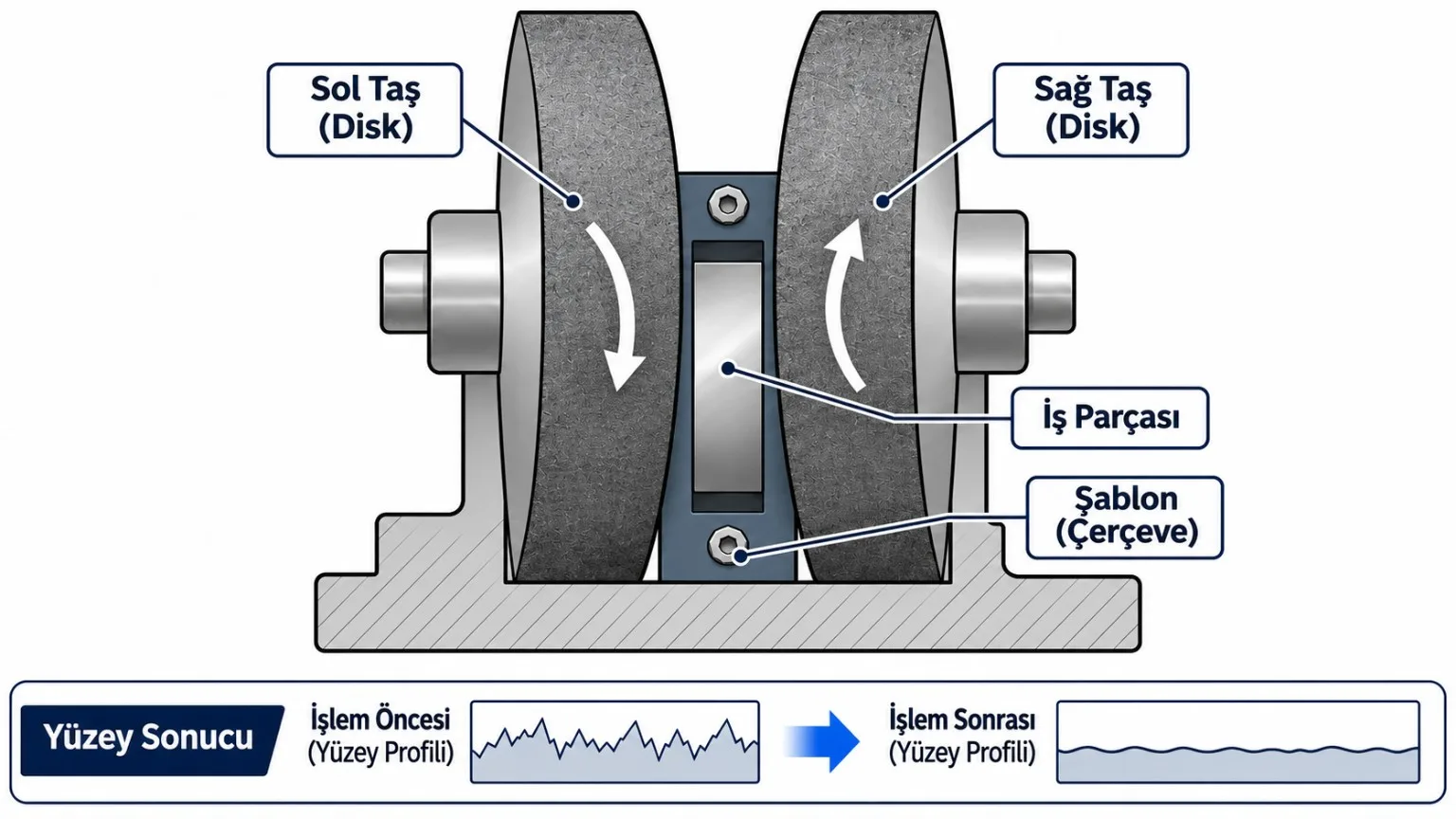
First, the thickness, diameter and material of the part and the two surfaces to be ground are examined. A suitable carrier is then selected and the workpieces are placed in its pockets. During operation, the opposing wheels remove material from the upper and lower surfaces of the parts. The relationship between carrier movement and wheel speed determines the wheel contact path and the process time. Suitable cooling is used to keep the effect of heat under control. After processing, the thickness of the parts, the parallelism between the two surfaces and, if required, the roughness are checked.
Wheel diameters
Ø400, Ø600, Ø700 and Ø900 mm. These values are wheel diameters; they are not the largest processable part diameter.
Which parts are suitable?
In automotive production, double-sided grinding can be considered for shims, spacer plates, some valve elements, discs and similar parts. In machine building, it can be considered for approaching the target size on some plates, seating surfaces, flange-type elements and precision spacers. Which method is used for which part depends on production volume, material and the values on the technical drawing.
Expected technical characteristics
For parts with suitable geometry, it can offer machining of both surfaces together, thickness control and a repeatable machining approach. At the same time, cooling, wheel dressing, wheel wear and feed conditions must be taken into account continuously. Where necessary, precision final finishing can be carried out by lapping after grinding.
The basic difference between lapping and double-sided grinding
Lapping is a precision finishing method that generally works with loose abrasives and aims at low stock removal. Double-sided grinding, on the other hand, works with abrasive grains bonded in wheels and has different characteristics in terms of material removal capacity and approach to size. The two processes do not have to compete with each other: for some products, double-sided grinding brings the part close to the required size, and lapping can be applied as a second stage for final surface requirements.
What information should you send?
The part name or code, technical drawing, material grade, hardness, initial and required thickness, tolerances, flatness/parallelism expectations, Ra/Rz targets if any, an image marking the surfaces to be processed, annual/batch quantity and expected lead time all speed up the quotation process. A suitable file transfer method should be used for confidential technical drawings.
Grinding wheels we use
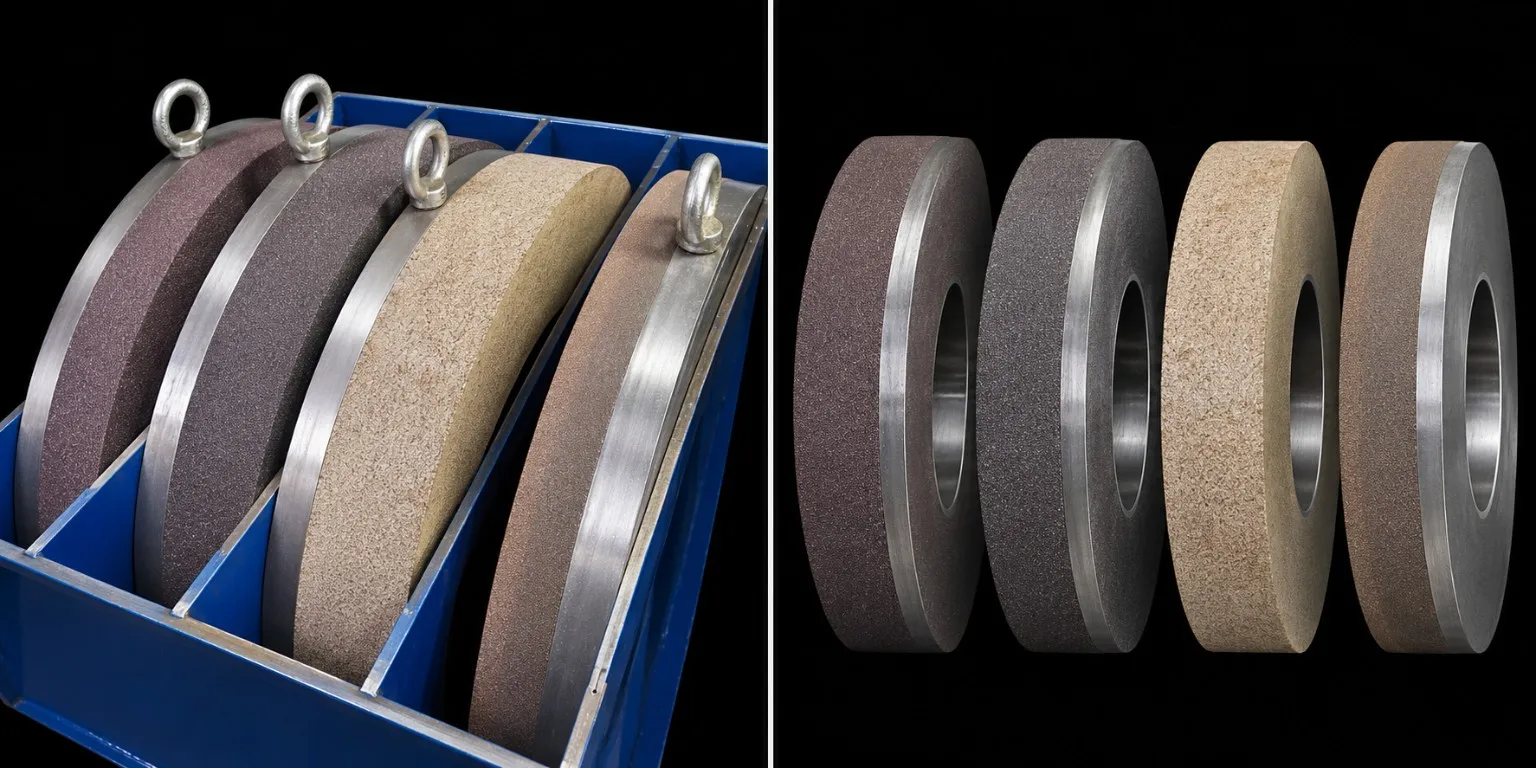
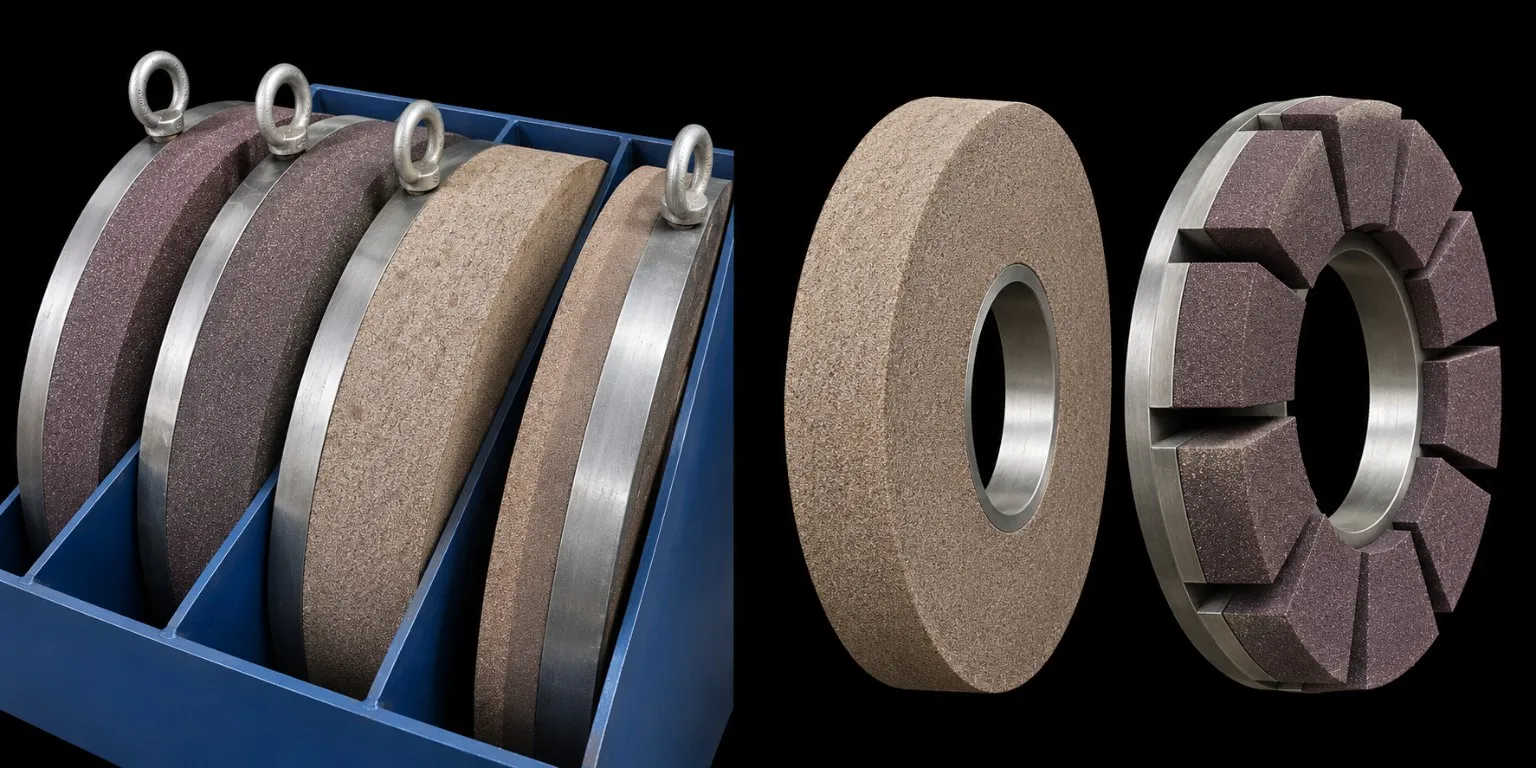
SSS
Frequently asked questions
What is double-sided grinding?
It is a method in which two opposing surfaces of a workpiece are machined simultaneously between two abrasive grinding wheels. The parts are guided by a suitable carrier system.
Is your grinding conventional surface grinding?
No. The process we describe here is a double-sided grinding system with two opposing wheels. It should not be confused with conventional single-wheel surface grinding.
Are lapping and double-sided grinding the same?
No. Conventional lapping relies on a loose abrasive slurry, whereas double-sided grinding is carried out with opposing bonded abrasive wheels. The fact that both use carrier systems does not remove this basic distinction.
What is parallelism?
It is an orientation requirement of a surface relative to a specified reference surface. It can be important for parts that function on both faces.
Can I send a sample before processing?
You can request sample work together with the technical drawing, material and required surface conditions. Suitability and acceptance criteria are clarified after the evaluation.
How much material is removed by the process?
It varies according to the part, initial thickness, target dimension, abrasive and process time. There is no fixed universal value.
In which industries is it used?
Lapping and double-sided grinding are generally used in automotive, machine building, valves/pumps, sealing, hydraulics and suitable precision mechanical parts.
Can grinding be required before lapping?
Yes. If the initial surface is rough or a large amount of stock must be removed, suitable grinding can be considered as a preliminary operation.
Let us review your part.
Send us your technical drawing and target surface requirements, and we will determine the right process together.